
A Little Bit of Everything
A compact science digest on Zealandia, ancient whales, chimpanzee rhythm, sarcophagi near Luxor, and interstellar travel.

The Mystery of the Seventh Continent
Scientists have discovered the sunken continent of Zealandia in the Pacific Ocean, 95% of which is hidden under water. The size of the land mass is comparable to Australia, and researchers have begun to actively study it.
Geologists define a continent as an area that includes a shelf, a slope, and a foothill. New Zealand, although located on an elevation, is not considered a separate continent, but is part of Zealandia. This continent, once part of the supercontinent Pangea, separated about 23 million years ago. Satellite images show that its crustal structure is similar to Australia and Antarctica, but Zealandia has not yet received official continent status.
Fossils of Jurassic forests have been found on the ocean floor, confirming the existence of land in the past. Significant tectonic changes are not expected in the near future, but in tens of millions of years, with global cooling, Zealandia may rise above the water again, opening up new territories and resources.
Zealandia remains a scientific mystery, the study of which will help to understand the geological processes and prospects of the hidden continent.
Ancient whales walked beyond the edge of the sea
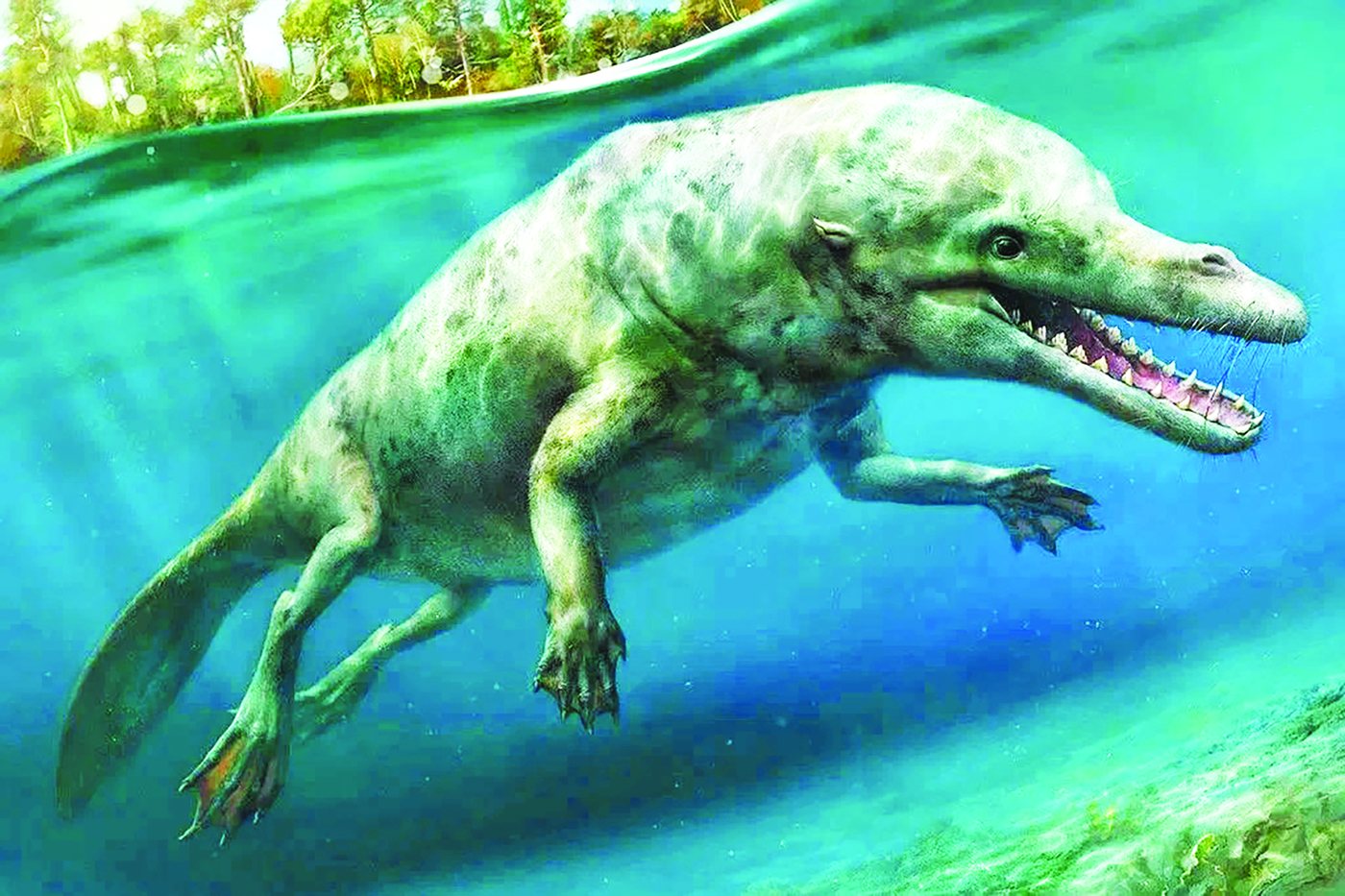
The remains of an ancient whale that could go out on land have been found.
Remains of an ancient ancestor of whales that could live both in water and on land have been found in Egypt. This protocetid whale lived about thirty-five million years ago.
Protocetids are an extinct group which retained well-developed front and back limbs. Remains of these amphibians have been found in America, Asia, and Africa.
Paleontologists from the University of Michigan say that unlike modern whales, their distant ancestors, the protocetids, were just exploring the ocean. They still had limbs that they could use to move around on land. It was previously believed that protocetids became completely extinct about forty million years ago, but the new discovery indicates that these creatures lived later.
The remains belong to the genus Aegicetus gehennae, which was first discovered in 2007 in Egypt, in the so-called "Valley of the Whales." By now, scientists have managed to reconstruct two-thirds of the skeleton of this ancient species.
"The male was 370 centimeters long and weighed around 900 kilograms. It moved through the water using wave-like movements - roughly the same way modern crocodiles swim," the researchers say, noting that the find will help better understand the evolution of whales.
Observing chimpanzees helps us understand human dancing

Researchers from the University of Warwick have found that chimpanzees can sense rhythm and move in sync. According to scientists, the behavior of these primates can help us consider conditions that may have led to the emergence of "one of the most inspiring and rich forms of human self-expression."
Many animal species perform instinctive or imprinted forms of dance, such as when courting a potential mate - but primates do not have such dances. However, for humans, dances are learned for social activities or rituals. Scientists have long been interested in how the proto-stages of dance developed in ancient human ancestors.
Chimpanzees, genetically speaking, are one of our closest relatives. In terms of intellectual development, an adult animal is close to human toddlers in many tests. Due to this relationship, studying their habits and behavior can tell us a lot about how the culture of our distant ancestors developed.
Observation of Holly and Bahkahri, a pair of female chimpanzees living at the St. Louis Zoo, showed that they learned to move in sync with the movements of their partner. Analysis showed that this is not a consequence of spying on the behavior of the staff and is in no way connected with the performances that were previously held at the zoo: the pair of monkeys appeared there sixteen years after the performances stopped.
Researchers studied twenty-three videos of Holly and Bahkahri dancing, recorded since 2011. According to them, this is the first time such behavior has been recorded, where one can be sure that it was not copied from external sources. The pair arrived at the zoo when they were four months old, and were constantly observed.
The chimpanzees synchronize their movements with each other in a dance resembling a kind of conga. The researchers note that after studying the video, they discovered that the synchronization between them was not random but predictable. Their movements were maintained to the second and were jointly executed. The level of coordination of movements, synchronicity and rhythm was similar to the level of orchestra members performing a piece of music.
According to the authors, the dances of these primates empirically show that dance in humans and their ancestors evolved as one of the mechanisms of social cohesion among small groups. Synchronized movements helped to cultivate community and collectively relieve stress.
Twenty sarcophagi several thousand years old found near Luxor
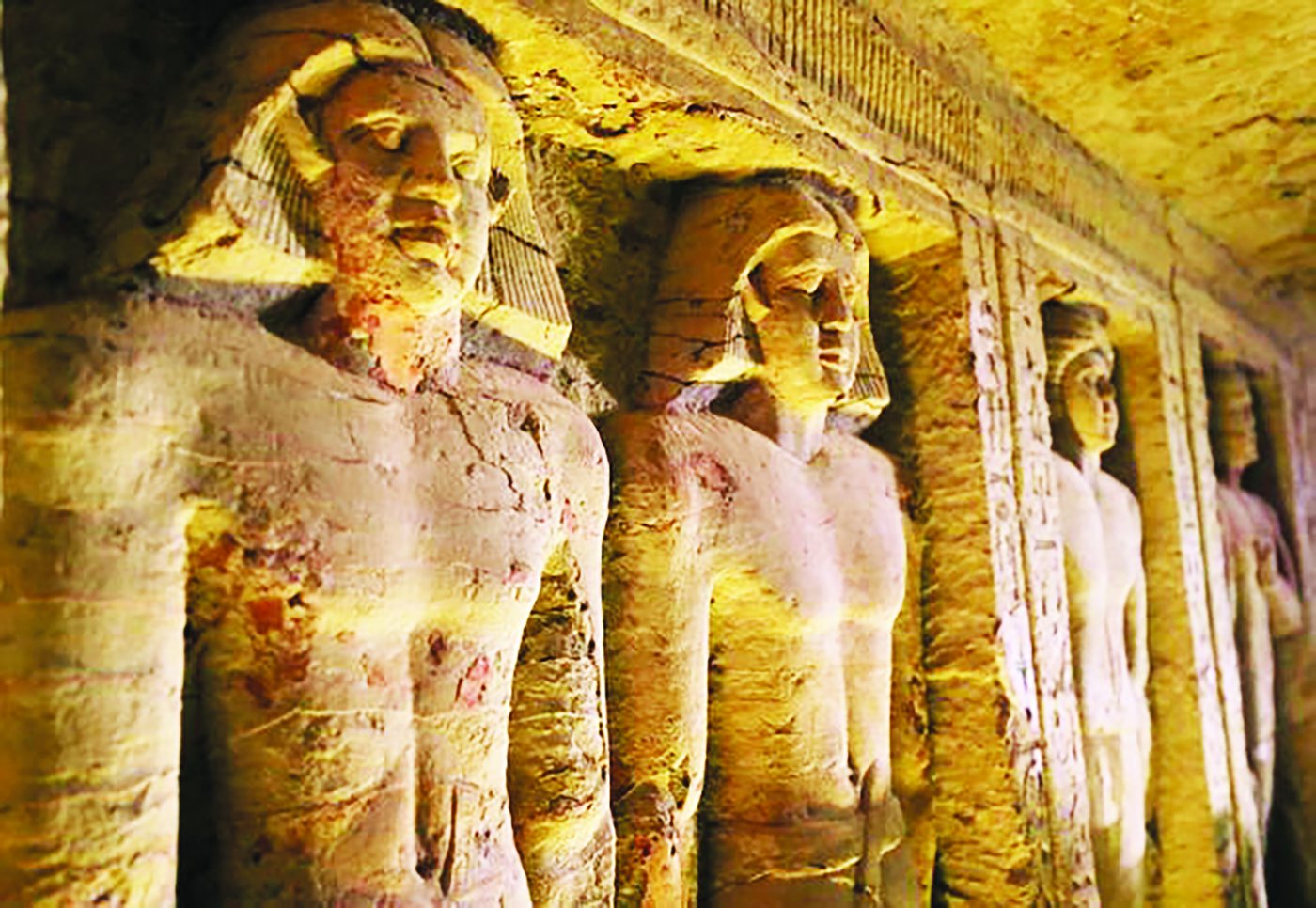
In a necropolis near the Egyptian city of Luxor, archaeologists have discovered well-preserved sarcophagi several thousand years old. The find was immediately recognized as incredibly valuable.
Scientists discovered more than twenty sealed wooden sarcophagi in the El-Assasif necropolis on the west bank of the Nile, not far from the ancient Egyptian capital of Thebes (now Luxor). The area includes the Valley of the Kings, where pharaohs, high-ranking representatives of the nobility, and officials were buried during the New Kingdom (1550-1069 BC). Egyptian scientists said that this find could be one of the most important in recent years, and the Ministry of Antiquities promised to issue a detailed press release dedicated to it.
A few years ago an international team of archaeologists discovered the tomb of the wife of Pharaoh Djedkare Isesi (2365-2322 BC) from the V Dynasty (2435-2306 BC). The sensational find was made during excavations in the south of the Sahara, where the necropolis of the rulers of Egypt during the Old Kingdom was located. The shape of the tomb is similar to those in which the first pharaohs were buried. It consists of a superstructure with an L-shaped chamber for ritual offerings, which was once decorated with bas-reliefs. Unfortunately, only the lower part of this decoration has survived. Blocks from the upper part were used by following generations as material for other buildings. Another discovery by archaeologists was the text carved on one of the columns. The writing indicated to researchers that Queen Setibhor, who was the wife of Pharaoh Djedkare, was buried in the necropolis. According to scientists, the thieves visited the necropolis in ancient times and all of the tombs were plundered. It is notable that not long ago, during excavations in Egypt, archaeologists found a mummy with a face similar to an alien. In total, scientists extracted about ten mummified creatures from the ground, many of which were quite well preserved. Most of the mummies found had elongated skulls. The scientists, who did not find any explanation for this, said they intend to continue studying the findings in laboratories.
Scientists plan a thousand-year flight to another planet

If there is soon nowhere to live, we must prepare for new achievements.
What will happen to us if we make our planet completely uninhabitable, because of changes to its orbit or the surface?
Some may say that we will all die, but scientists from the Interstellar Research Initiative say they have other plans. Instead, they propose sending a team of colonists to the nearest potentially habitable exoplanet located in another star system. For example, to Proxima Centauri B. Yes, it will take a thousand years to reach, if not more. Yes, more than one generation of astronauts will be needed. It is very likely that the ship will fall apart and simply not reach the target. Nevertheless, from the point of view of scientists, the task is theoretically feasible. It does not violate fundamental physical principles and looks quite rational. The main thing, experts believe, is to prepare well, and if possible, in advance.
Based on current research, even a flight to Mars is impractical, since scientists have not yet found an effective way to protect astronauts from deadly cosmic radiation, and medical issues related to staying in space are still poorly understood. Plus, what will happen if the planet, to which we have to fly for a thousand years to reach, turns out to be not as hospitable as it seems to us from the lenses of telescopes? The enthusiasts from the Interstellar Research Initiative do not answer this question. Apparently, the excitement of the flight itself is more important to them than the result.
More from Education

The History of the English Language
Jeremiah Hendon's accessible tour through Old English, Norse and Norman influence, Middle English, and the language's global reach.