
The History of the English Language
Jeremiah Hendon's accessible tour through Old English, Norse and Norman influence, Middle English, and the language's global reach.
The English language is perhaps one of the most important languages of the modern era. Being both the third-most spoken language natively and also the single most-learnt as a second language, with a ratio just shy of 3:1 of second-language speakers to native speakers, and almost 1.5 billion total speakers.
It's an official language of the North Atlantic Treaty Organization, of the European Union, and the United Nations. It's the official language of the United States of America and the former British empire, one of the most powerful empires in history. Yet the language itself is not nearly as studied as the people who have used it.
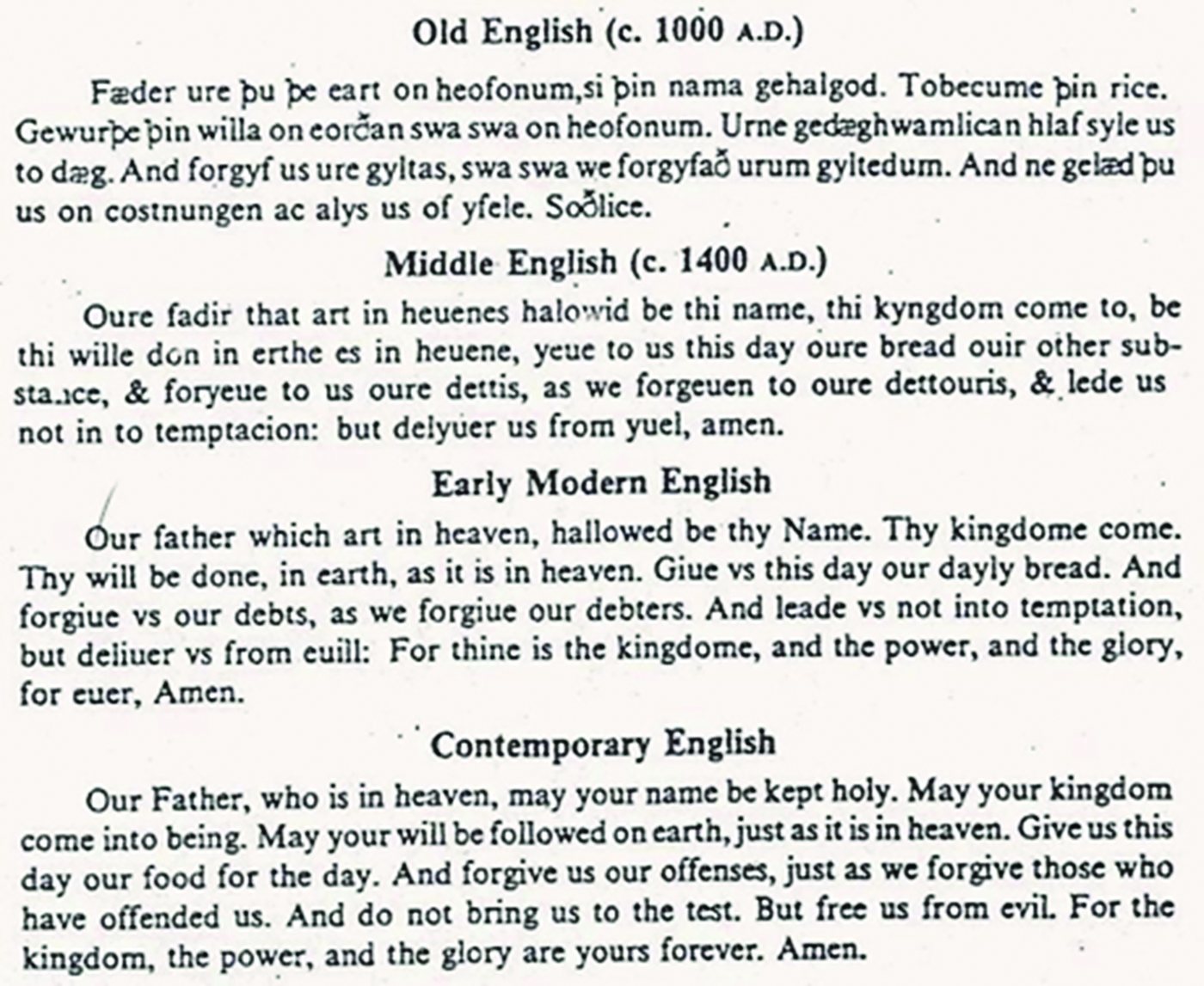
The English language itself has a very fascinating and very complex history, deeply intertwined with the history of England itself. Its legacy continues on with every day that it is spoken, changing both itself and other languages of the world.
The English language is a member of the West-Germanic branch of the Indo-European language family, originating from the Proto-Indo-European language spoken in the fifth millennium B.C.E. in-and-around what is now modern-day Ukraine. The Indo-European language family is also the family behind the Indo-Iranian languages, responsible for Romani, Hindustani, and Persian; the Italic languages, responsible for Latin, Spanish, French, Portuguese, and Italian; the Balto-Slavic languages, responsible for Polish, Ukrainian, many languages of the Balkans, Russian, and Lithuanian; and the Germanic languages, responsible for the Nordic languages, Dutch, German, and Icelandic, all among others.
Yet, the English language is not bound only to its linguistic heritage, and has frequently taken and given features and vocabulary between other languages in the Indo-European family and beyond. While the grammar system and many of our most common words are Anglo-Saxon in origin, more advanced vocabulary is almost always loaned from another language. Out of all English vocabulary, only 26% originate from Germanic languages, whereas 29% originates from Latin, and another 29% from French; Over half of the vocabulary of the English language is not English, or even Germanic in origin, but from the Romance languages. This is all due to the unique history of England, where the language developed.
Old English (also called Anglo-Saxon, and endonymically called Ænglisc), the oldest known iteration of what is now the English language, originated from the Ingvaeonic (also known as North-Sea Germanic) dialects of the Germanic language spoken across the North Sea in-and-around the fifth century A.D. It was brought to the British Isles by Vikings in two waves: the first in 450 A.D. by Frankish Vikings from what is now northern France, and the second around the year 500 A.D. by Nordic Vikings from what is now Sweden and Norway.
Before these Vikings landed in the southern and eastern coasts of England, the land belonged to the Roman Empire and formed the province of Britannia (where the name "Britain" finds its origins), who themselves had actually conquered the area from the Celts, another Indo-European people-group who spoke an Indo-European language, Brythonic. The Brythonic language is not nearly as well documented as English, but from contemporary sources we can tell it is the language that eventually evolved into the currently-existing Celtic languages: Irish, Scottish Gaelic, Breton, Manx, Welsh, and Cornish.
These Viking settlers brought their own Germanic Dialects to the island, and over time they together melded into five distinct dialects of Old English: East Anglian in the East; Kentish in the South-East; West Saxon in the south; Mercian (which later became the basis for Modern English) in the Midlands; and Northumbrian in what is now northern England and southern Scotland. These very early forms of Old English are today completely unrecognizable to Modern English speakers without thorough knowledge of the language itself or of old Germanic languages of the time.
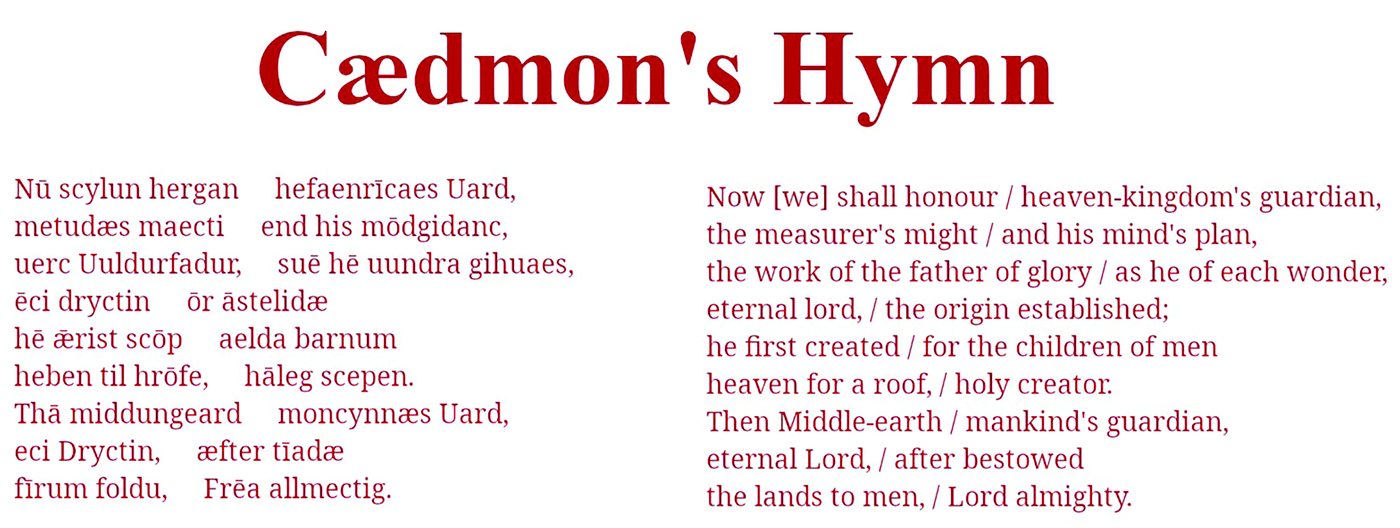
Few legible writings survive from this period. The Anglo-Saxons wrote in a runic writing system called Futhorc (named after the first few runes in order) until around the eleventh century, when Christian missionaries popularized the Latin system (which was then modified with runic outfits by the Anglo-Saxons, though none of them survive to the present day). Cædmon, an illiterate cow-herder, is credited with the first piece of Old English literature. Called simply "Cædmon's Hymn", it was a poem in Northumbrian dialect praising the Christian God, which was then recorded by the monk Bede (b. 673 - d. 735) who dated it to sometime between 658 and 660 A.D.
Though Old English eventually became the language we today speak, it first had to be molded by its new environment, and even though it displaced the preceding Brythonic peoples, the English language did not take much from the common Brythonic language of the time. Instead, the first significant instance of Old English taking features or vocabulary from surrounding languages was from Old Norse, the language of the Danes, where we got much of our most common, core vocabulary.
In the early ninth century, Danish Vikings would often raid the eastern coasts of England, demanding tribute (called Danegeld) as payment to return back to their homeland. However, in the year 865, a coalition of Scandinavian warriors, now called the Great Heathen Army, invaded England with the intent to conquer.
After landing in Kent, they destroyed every Anglo-Saxon kingdom except Wessex, where they were defeated by Æthelred I. The Great Heathen Army split into two; one half went north to raid Scotland, eventually conquering and settling in Northumbria, whilst the other half went south, eventually attacking Wessex again, where they were completely defeated by Alfred the Great, king of Wessex and brother of Æthelred I. Now, Wessex, the only remaining English kingdom, shared the island with a new Danish kingdom along the east coast: Danelaw.
After the establishment of Danelaw, the English language saw an introduction of new vocabulary. While the vocabulary loaned from Old Norse to Old English was minimal (only between two and three per-cent of the total vocabulary) they are now words we use quite often today. Old English and Old Norse were in common use and in equal standing between Wessex and Danelaw.
The more major changes to the English language would come after a later invasion, that of the Normans in 1066. This is where the Anglo-Saxons as a cultural group would cease to exist, and the language would become much more recognizable to anglophones today.
The Normans were themselves Norse Vikings quite like the Danish, and settled in West Francia in the year 911. However, unlike the Danes, who, during their settlement of England, stayed independent in their own kingdom, kept their own laws, and spoke their own language, these Vikings pledged fealty to King Charles III of West Francia, and became a Duchy.
Over the next one-hundred years, the Vikings mingled among the locals of West Francia to such an extent that they lost their ethnic identity, their language, and their heathenry. The Vikings and West Francians blended to the extent that a new Norman cultural identity emerged, being neither Norse nor French. Their language, Norman French, is at its core a romantic langue d'oïl language like many in-and-around France, however it has multiple Germanicisms that originate from the Norse. Norman French is still a language spoken in modern-day Normandy and its descendant dialects are official languages of Jersey and Guernsey.
When the Normans invaded England in 1066, unlike the Danes, their victory was fast and decisive. Harold Godwinson, at the time king of England, was unable to fend off the incoming invaders and was killed at the Battle of Hastings on the fourteenth of October, 1066. Only a month after the Norman arrival spearheaded by William the Conqueror, Duke of Normandy, in early September.
The Normans, now reigning over all of England after William the Conqueror took the throne, francified the country. The Germanic societal structure of the Anglo-Saxons' England was done away with, and instead the island adopted a starkly different, French, way of life. New, French aristocrats came to dominate high society. Old English lost its position as the prestige language of England (being relegated to the language of the peasants) and French took its place.
Old English losing its prestige status allowed for it to be molded extensively by its francophone surroundings. All of the educated and powerful people spoke French, and so mingling among the higher and lower classes francified the Old English language to such a degree that it no longer was the language that it was before the Norman Conquest. Old English had ceased to be a living language.
This next stage of the English language, Middle English, was spoken only by the lower classes until the end of the fifteenth century, and was very different to the preceding Old English. Whereas Old English was an very grammatically complex language, and was very conservatively Germanic, Middle English was not. During the Norman rule of England, Middle English lost its synthetic inflections, many of its grammatical endings, its strong and weak plural system, and its grammatical gender.
Spelling was also changed under Norman rule. Whereas before the Normans, English had been using ð and þ, respectively pronounced /ðæt/ "that" and /θɔːrn/ "thorn", (the former being a Norse letter of the Latin alphabet, and the latter being a vestigial character from the Elder Futhark rune system used by the Norse) to pronounce the sounds /ð/ and /θ/ (both respectively the 'th' in "then" and "thin"). Under influence of the Normans, these, among other archaic characters, were discarded in favor of using letters that existed in the Norman Latin alphabet, this meant changing to using 'th'.
The English language did not see a resurgence among the higher classes until the thirteenth century, when the Provisions of Oxford, a set of constitutional reforms, were the first government document to be written in English in over two-hundred years. In 1362, king Edward III addressed the English Parliament in the English language, and the Pleading in English act of 1362 solidified English as the only language in which court proceedings could be held (though official records were still kept in Latin). By the fifteenth century, the courts had switched entirely from French to English.
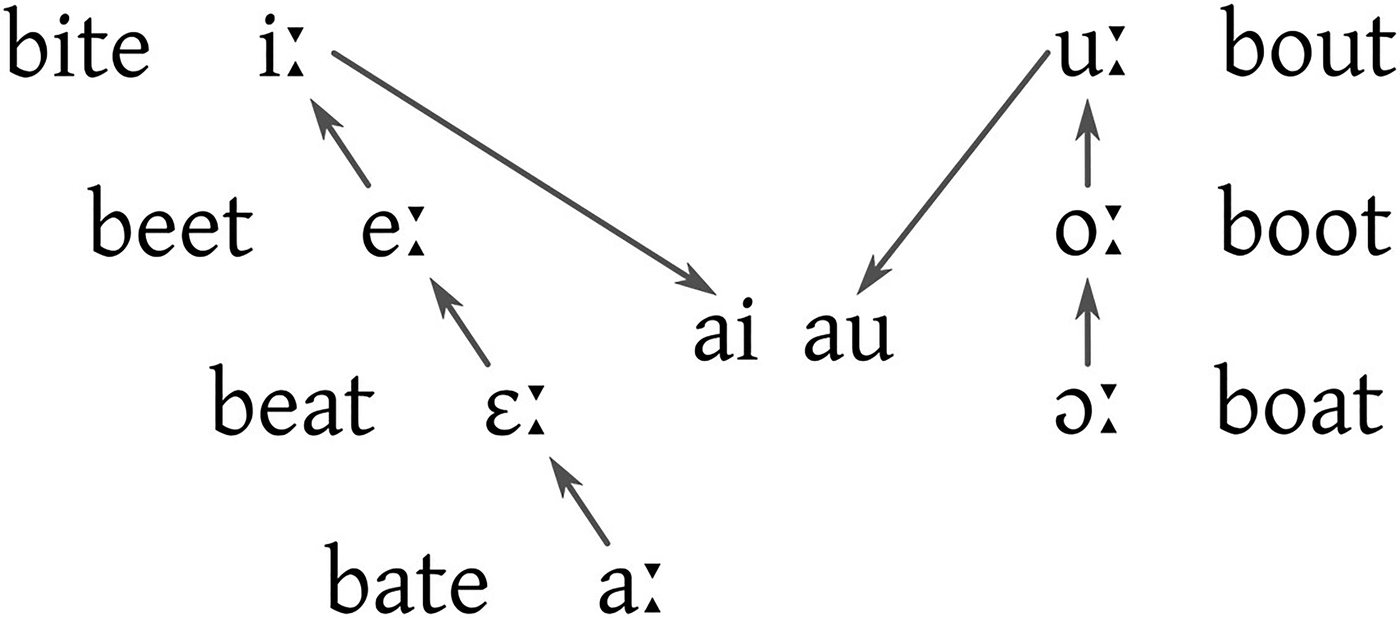
The point of divergence from Middle English to Early Modern English is not a fine line, but is generally regarded by linguists to be marked by an event in English phonology called the Great Vowel Shift, where, starting in the fifteenth century and ending in the seventeenth, a change in pronouncing the vowels of the English language was popularized in southern England and spread across the island. The cause for this event is variously attributed to either the Black Death and resulting mass immigration, French loanwords, middle-class Londoners wanting to sound like Normans, or wars with France making Londoners want to sound less like the Normans. This new, more modern English is now at a stage where English-speakers can decipher it without prior knowledge and is quite close to the English we now speak. This is the form of english that Shakespeare, among many other famous contemporary englishmen, spoke.
Over centuries the english language changed. It simplified further and, as grew the influence of the English and eventually the Americans, so too did the English language grow in influence and prestige. Eventually, it came to linguistically dominate the world the way it does today.
The English language has an extremely interesting history behind it, having survived multiple conquests and contacts with other languages. Today, it is a language of some of the world's most influential powers. It is the most far-reaching and most-learnt language on Earth. However, it's important to know how the language became what it now is, and how it changed throughout millennia as well as its land of origin.
More from Education

A Little Bit of Everything
A compact science digest on Zealandia, ancient whales, chimpanzee rhythm, sarcophagi near Luxor, and interstellar travel.