
Psychological Etudes: About Dreams, Deception and Love
A long psychology feature about dreams, deception, love, and the inner work of returning to yourself.

"Perhaps the most exciting and mysterious universe of all is the one that is inside us."
Why are our desires not fulfilled? How to make dreams come true
Let's look around and enjoy the view of nature, eternal and ever-renewing. Let's try to understand or feel what the world around us is trying to tell us. Perhaps in the depths of our hearts we will hear the words that nature itself seems to whisper to us: "Life is beautiful!"
It is impossible to not believe in this message-it is enough just to open your eyes and look around. Trees wither and come to life again, endless fields are empty, then dress again in bright clothes of flowers, and the sun's rays generously illuminate all this splendor. This powerful natural impulse does not pass without leaving a trace for us. We set new goals, and dream of different life horizons. But our desires are not always fulfilled. Why is this happening? What needs to be done to make the dream come true?
"Never stop dreaming! A dream man needs as much as air. However, dreams need not be breathed-they need to be translated into reality."
E. Safarli
Modern psychologists and coaches know a thousand and one recipes for making dreams come true. Specialists of this type will be happy to share with you one of the recipes; most often for money. However, there are simple reasons that can help you figure out why dreams don't come true.
Two reasons why dreams do not come true
The first reason is simple, like everything ingenious: your dream does not come true because it is not your dream! Look inside yourself and ask, "Did I really dream of becoming a dentist? A teacher? Or is it my friend, mother, or sister who forced this dream on me?" Note that we are talking about significant people in your life. Perhaps for you this is a grandmother, a husband - in a word, someone's whose opinion is significant.
Imagine for a moment: mom brightly and picturesquely tells you how great it is to be a teacher, and to see the sincere, grateful eyes of students. And you believed it was great. And your husband said how wonderful it is to buy an SUV…so silvery, costing two apartments. But this is nothing, for the whole family to reliably ride on it to the sea, where there is a sunset and palm trees. The race for the dream begins. But it doesn't come true-an expensive SUV is too expensive, palm trees are far away, the car dealer doesn't give credit, you lost your job. Motivation is lost. But in fact, if the dream is yours, then the motivation cannot disappear.
The second reason why what was conceived does not take on real features is rather prosaic. The dream does not have a solid foundation under it. To make it clearer, let's give an example. Suppose you are a mother of many children, your education is rather modest, and your whole life was spent in a remote village where you worked in the canteen, first as an assistant, and then as a cook, with a break for maternity leave. But at the same time, this mother with many children has a dream: she intends to become the president of a large corporation, manage a business, and have thousands of people under her command. If suddenly you subtly hint to a woman that her dream is not entirely real, then you risk making yourself her enemy. Because the dreamer has already gone through a lot of trainings, hearing valuable advice from coaches (for money, of course) that everything is possible-you just have to want it. Yet, she does not know the basics of management nor foreign languages and does not understand a bit about economics! Yet, she is not part of such a social circle! So, let's be honest with ourselves, and put our skills and talents on one side of the scale, and what is really needed to take such a post on the other. After analyzing, it suddenly turns out that becoming a director of a corporation is unlikely to work, but evolving from a canteen chef to a manager of a large restaurant in a neighboring town is very likely and quite achievable if you put in a certain amount of effort.
Simple secrets: how to make your dreams come true

To make your dreams come true, be honest with yourself. Understand yourself, analyze, and answer simple questions. What does your soul live for? What is truly valuable to you? What are your true desires? Are you on the wrong path?
The second thing to do is to clear the space, and to get rid of anything superfluous. This means to get rid of not only old things, but also negative thoughts, toxic relationships, and longing for the past (in which you cannot change anything).
The next step is to make a plan in writing. When making your list, make sure your dreams and goals are not abstract. A collage of pictures will also help you, so that you visualize your dream. Dreaming of a home? What exactly will it be? Where? How many floors? Find a suitable picture, place it on a large sheet, and let this clear image be seen by your eyes. Once you've taken these simple steps, you will be surprised how much closer you will be to your cherished dream-which will certainly lead to happiness!
Five reasons why people lie

Several years ago, the news broke of a woman who lied to her husband for nine months about an alleged twin pregnancy. Many people spoke about this case, and many were agitated. Probably, no one would have known about this situation if the angry spouse had not unleashed his anger on the doctors. The unfortunate father claimed that the doctors were to blame for the death of his offspring.
An investigation began and the blatant truth was revealed: the woman was never pregnant nor did she give birth. Later, trying to justify herself, the woman said that at first, she wanted to please her husband with pregnancy, and then she herself believed in this monstrous lie. The husband dreamed of children, and for all nine months did not suspect anything was amiss. The reader reading these lines has probably already thought, wasn't it easier to tell the truth right away? Why lie like that? We will try to find an answer to this question: why do people lie?
Psychologists identify five reasons why people cheat:
1. To avoid minor conflicts.
Life is made up of little things. Sometimes it is easier to tell a spouse a false compliment, rather than a painful truth. Sometimes, no one wants that kind of truth. Let's say the wife bought the wrong dress, according to her husband. How can he tell her? Express his opinion bluntly, or give a compliment? Is it worth spoiling the mood, if we are only talking about clothes? A harsh statement can hurt self-esteem, ruining not only the couple's evening, but also family relationships.
2. Because it is profitable.
If in the first case, the lie had good intentions, but in this case the lie has materialistic motives. For example, people may deliberately cheat in order to get a promotion or other preferential treatment from their superiors.
3. Small lies breed big ones.
Sometimes one lie becomes the reason for subsequent lies, as seen in the first example with the pregnancy lie. At first, the woman lied about her pregnancy. Then, she had to think up many other maneuvers to confirm it. A small lie, which at first could be compared with a lump of snow, after months turned into an avalanche and fell not only on this family-but also hooked many people with its shock wave.
4. A special type of personality.
There are people who lie at every step. They lie, so to speak, out of love for the art. Each time they invent a new reason to lie. At first, it is profitable for them, then it is convenient, and after that they are already lying and deception becomes their lifestyle. The origins of this behavior could be found in their childhood. Perhaps this person grew up in a poor family yet wanted to occupy a higher status, which for his family was unattainable.
5. Lie to the rescue.
Sometimes it's not safe to tell the truth. For example, openly telling everyone you meet about the intimate details of your life is not advised. It is much easier to lie or avoid answering questions. There are many known cases of domestic violence, and wives are more likely to suffer. Therefore, sometimes it is easier to lie than to honestly answer questions to a loved one, if suddenly the answers will not suit him.
These are the main reasons for lying. Concluding the article, I would like to recall the ancient wisdom: "Everything secret becomes apparent." Remember this when you decide to tell a lie.
Hypocrisy and bigotry: signs, reasons

Have you noticed that when dealing with some people you feel discomfort? You ask yourself why, but don't find the answer. Outwardly, the person you are speaking with is a pleasant person, and communicates politely. Yet, the feeling of tension during dialogue with him does not leave you. What is it: intuition or subjective opinion? Let's figure out how to identify if someone is pretending, and how to recognize his/her true intentions.
A two-faced person, as a rule, is emphatically polite, from him/her you will not hear a single contradictory word; he/she smiles at you sweetly and nods in agreement. But as soon as you turn your back on him, he will immediately condemn you, or give away your secrets, if it suits him.
Let's list some signs to tell if someone is a wolf in sheep's clothing.
Seeking favors: the strong assert themselves at the expense of the weak
A hypocritical person is clearly oriented in the social hierarchy. He will scatter servile compliments to the management of the company in which he works. Yet, his admiration for authority ends at the exact moment the boss loses status. After all, a snob easily humiliates the weak, as well as any person who depends on him.
Cheating family and friends without a twinge of conscience
Not only is it dangerous to work with two-faced people, but also to live with them under the same roof, or to make friends with them. Remember that they humiliate the weak? Moreover, they deliberately make efforts to make others weaker and thereby raise their own self-esteem. Do you think that your friend sympathizes with you when she listens to your complaints about family problems? Not at all. A friend, like a fox, will nod and sympathize, looking into your eyes-yet you will not see her inner glee. But as soon as you complete your confession, everything you have told will immediately be told to others, which will cause serious damage to your reputation.
They help if it is profitable
You cannot expect unselfish help from such a person. Altruism is not his strong point. If the pretender is not offered specific compensation for their help, then he will find hundreds of excuses to avoid unnecessary work. It is very difficult for such people to build relationships, with family and friends. He mentally writes down every step he takes in someone's direction. It is dangerous if you receive something from him and do not do something in return. Sooner or later, he will take revenge on you for using them and not giving anything in return.
Frequent fake compliments
Not all pretenders can lie beautifully and skillfully. A hypocrite can be seen for his clumsy compliments, which he distributes right and left. He may also try to gain your confidence by telling someone else's secret. But do not flatter yourself. In five minutes, he can tell others about your secrets-if you have the stupidity to confide in such a person.
Why people become hypocrites
Antoine de Saint-Exupéry once said that we all come from childhood. Psychologists are sure that the reason behind the tendency to lie must be sought in childhood. Usually, a child has a dissonance between what the parents tell the child, and what they themselves do. For example, parents may be very strict about smoking, constantly stressing how harmful this habit is to health. But such a speech they can easily make, lighting one cigarette after another. The child sees that hypocrisy is the norm.
It happens that overly despotic parents threaten their offspring with reprisal for disobedience. Then the child, like a skillful actor, plays different roles. At home-this is one child, and at school and with friends-another. It's like two different people. Years pass, and the child becomes an adult and there seems to be no need to act. But habit is second nature. Changing their behavior is not easy for such a person, and sometimes only a specialist can help.
"I had a strict father who demanded not only obedience, but also a reason to be proud of me. He didn't care if I felt good, or how my relationships with peers were developing. Only the grades on the report card were important. I hated algebra, and physics was not easy either, because I dreamed of becoming an actress. But my father did not care. If the grade was not the highest, I was punished." If she began to sob, then her father punished even more. "I had to be a smiling and affectionate girl who does what she is told to do. Once, I let it slip that I had enrolled in a theater group at school. My father hid the dresses and forbade me to go to school for a week until I changed my mind. I changed my mind. My mother was inactive and did not contradict my father. When I grew up and ran away from home, I discovered that I could not communicate normally with other people. I subtly lied to everyone, gossip to benefit myself and sometimes to please others. I didn't make my dream come true - I couldn't create a family. I had to go to a psychiatrist."
‒ From a private letter
Thus, many people carry this model of behavior from childhood. In childhood, interaction with people, such as with parents, helped them survive and avoid punishment. In adulthood, they learned to extract other advantages: they are hypocrites, because it is beneficial.
If you notice this unpleasant quality in yourself, then you should not be upset. Instead, make an effort to work through childhood traumas that make you bend your conscience.
Who is the boss in the house? How the roles are actually distributed in the family

The age of global restructuring of consciousness, and the age of transformation-such definitions are given to the 21st century. These changes have affected many spheres of life, and the institution of the family has not been spared.
If earlier, the role of a man was unconditionally considered the main role, today such a family model can be considered outdated. Let's put everything on the table and figure out this difficult and topical issue.
There are many basic family models. The role of a leader can belong to both men and women. There is also an intermediate option: equality. Roles are assigned at the dawn of a relationship, later, it is almost impossible to change shoes in flight and change roles.
Power in the family: distribution options
It is not the one who is blamed, but the one who values the relationship that asks for forgiveness. Simply, the one who loves less becomes the main one in the family boat. Others ask this person for forgiveness, even if they are innocent. It is from them that a lover is in a dependent position and is forced to seek their favor. Yet how can the boss flatter others? There is no way. The person in the position of a petitioner is the one whose love is stronger.
The person with the resources is in charge. For example, the unequal marriage of Cinderella and the prince can play a cruel joke on both spouses. The main thing, of course, is the prince-because he has all the resources: the palace, the servants, and the power. Cinderella has nothing but youth, which tends to pass away. Will such a couple be happy? The question remains open.
Sometimes the older spouse becomes the main one. So, a man can unconsciously choose a woman much older than himself as his wife. His wife will play the role of mom and, of course, she will own the dynamic. But more often, it happens that a girl chooses a husband-father who will satisfy her basic needs for paternal care. The wife herself will make such a spouse the main one.
How to properly distribute the roles in the house-and who should be in charge?
Psychologists agree that the best option for a harmonious family is equality. In such a family, there are no main nor secondary partners. The rights and responsibilities are divided evenly between the spouses. Building relationships in such a union will be harmonious. Meanwhile, creating a marriage based on childhood or psychological trauma does not bode well. The foundation of such a family is flimsy.
At the same time, there is nothing wrong with giving the reins, for example, in terms of finance, to your partner. The main thing is that both spouses have a detailed idea of what end result is desired-and whether this is aligned with your inner convictions. Be happy and loved!
More from Psychology & Sociology
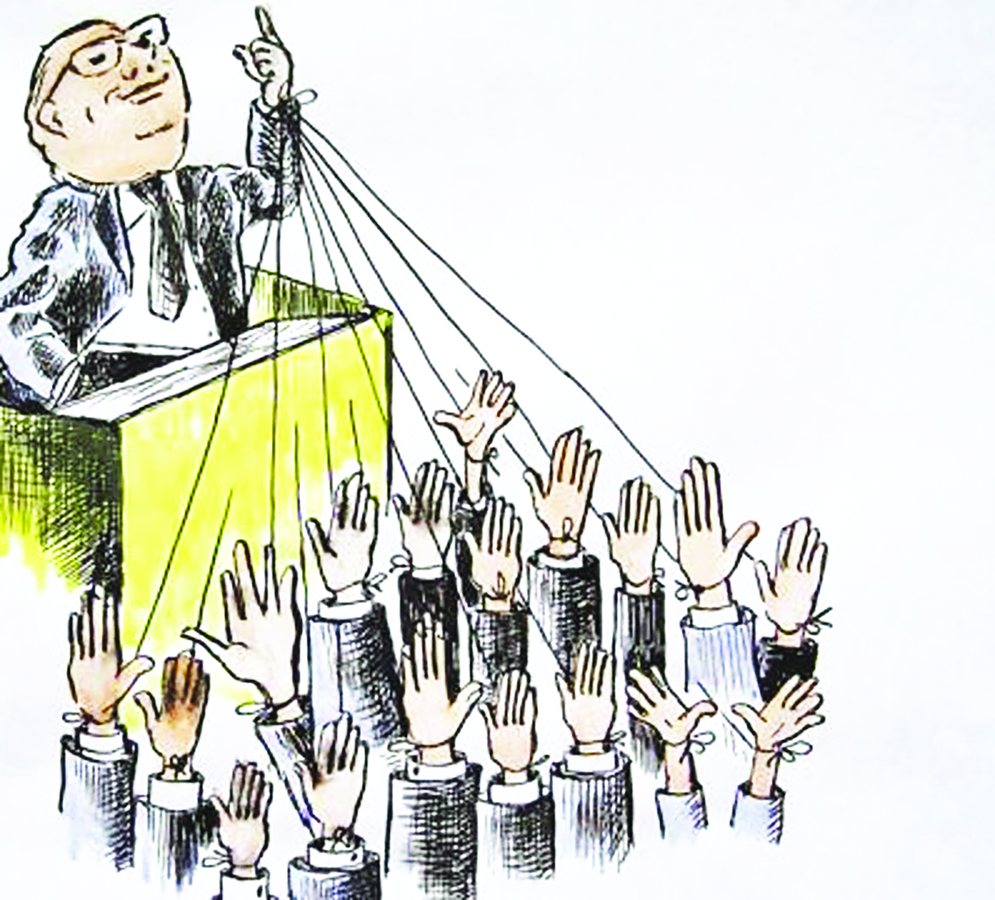
At the Head of the Pathocracy
An essay on pathocracy, personality disorders, leadership, and the social need to protect civic institutions.

Look Within: Return to Mysticism
A cultural and social essay on the renewed interest in mysticism, alternative healing, and inward-looking traditions.

Hypnosis as a System for Changing Consciousness
A psychology essay on hypnosis, suggestion, communication, and the changing states of human consciousness.