Flow: Silence Speaks Louder Than Words
A review of Gints Zilbalodis's animated film Flow, where quiet images become a meditation on survival, empathy, and community.
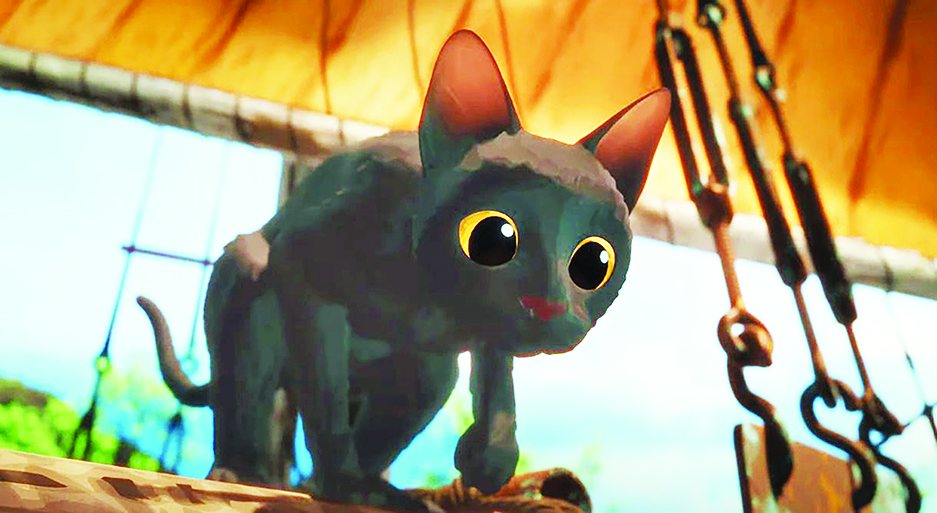
The man is gone. All that remains of him are his handiwork: a wooden house with a cozy round window on the second floor, a soft bed, a few blueprints, and enormous statues.
The space now belongs to a nameless black cat, who seems to genuinely enjoy his solitude-he spends his days running through the fields, studying his own reflection in the river, and skillfully eluding the dogs.
But everything changes when the land ceases to be a safe place and is covered by water. The cat finds refuge in a small boat, already occupied by an imperturbable capybara. Soon, a fashionable lemur, a wise secretary bird, and a cheerful labrador, who has strayed from a group of mischievous dogs, join the dream team. Together, the heroes must sail hundreds of kilometers before a piece of coveted land looms on the horizon again.
Latvian director Gints Zilbalodis's Flow is a loose adaptation of his short film Aqua which also featured a cat as the protagonist, who was caught in a sudden flood and saved by a random bird. Flow follows the same motifs, but uses a different narrative style and adds companionship to the equation. The image of the cat is likely borrowed from Zilbalodis's debut feature The Mysterious Island, in which a traveling boy unexpectedly stumbles upon a family of identical black cats. Flow as a whole could be considered part of a duology-or, with luck, a trilogy-about the director's fascination with unexplored spaces and the creatures that inhabit them.
Another common thread between the two films is the theme of cyclicality and circular motion. In Flow, one scene shows deer swirling in a ritual dance, with the protagonist at the center, while in The Mysterious Island, we watch cats slowly descend into a spiral-shaped depression in the ground that serves as their source of drinking water. Zilbalodis films both scenes from above, emphasizing the rotation, as if he were attempting to hypnotize the viewer with the rhythmic circular motion and immerse them in a state of tranquility befitting the film.
While the 24-year-old director created his debut film almost entirely alone, he worked with a team on Flow. Matisse Caja (The Taste of Water) co-wrote the screenplay, and composer Richard Zalupe wrote the film's score. Zilbalodis believes that his cartoons beautifully reflect the changes in his career. The lonely hero on the island represents his period of solo work. The independent cat learns to interact with other characters to survive, mirroring the director's attempt to learn to listen to and hear his colleagues. Thus, Flow becomes a story about acceptance: of changing conditions, unexpected neighbors, and other people's attitudes. Zilbalodis's conclusions are easy to grasp in the finale: the cat's fundamental need for independence turns into an unexpected realization-if you see someone else next to you in a reflection, then maybe it's a sign that everything is moving in the right direction.
The power of Flow lies not only in its utterly endearing characters, but also in the beauty of the frame and the clever use of camera angles-the film forces us to rethink the power of animation, which doesn't require human speech. The film has no words-the sounds the animals make are specially recorded "lines" from the characters, not artificially created sound effects. The team also spent many months observing the behavior of the prototypes in their natural habitats, filming them, and reviewing videos to capture the animals' behavior on screen with maximum accuracy. Fortunately, this resulted in the characters being far from anthropomorphic-they have nothing human about them, and perhaps it's high time we stopped thinking of ourselves as the center of the universe. As the film shows, the world existed perfectly well before us and will continue to exist after us. Perhaps these will be the best years of the planet.
The film has been called slow-paced, but you won't have time to get bored. Despite the measured narrative, every frame is filled with action or striking visuals. At first, the graphics seem unusual, reminiscent of a video game insert. Apparently, Gints strives to give the viewer a rather rare experience, which is precisely what captivates them.
Flow is an example of a project where silence speaks louder than words. This isn't just a cartoon, but a meditative journey in which nature triumphs over human civilization. If you're tired of clichéd plots, give this Baltic gem a chance. It might just be your discovery of the year.
The power of Flow isn't just in the visuals. It's a profound philosophical parable, packaged within a simple story of survival. The boat becomes a microcosm of our society. Here unfolds a miniature version of the struggle for leadership, blindly following instincts ('us' versus 'them'-the episode with the dogs is brilliant and brutal), the price of selfishness, and the saving power of empathy and mutual aid. The film subtly-without being preachy-shows how old stereotypes are crumbling and a new understanding of community is born that knows no boundaries between species. It's a powerful message: ultimately, in the face of adversity (be it water or life's catastrophes), it's not labels that matter, but actions and a willingness to lend a helping hand, even if it's a paw or a wing.
This is an emotional film. You'll hold your breath following the twists and turns of the journey, involuntarily rooting for each member of this motley crew, and perhaps even shed a tear at the climactic moment of sacrifice. The film leaves an aftertaste-a strange mixture of light sadness and quiet hope, forcing you to reflect on your place in the world and your connections with others.
Flow isn't just the best animation of the year (its well-deserved Oscar and Golden Globe awards speak for themselves). It's a rare instance when a film becomes an event that changes perceptions. It proves that true emotions don't need words, and that genius can be born in a modest studio using free software. Be sure to take the time to immerse yourself in this unique, captivating, and incredibly human flow. You won't just not get bored-you'll emerge a changed man. And perhaps, like thousands of others, you'll consider giving a black cat from a shelter a home.
Flow premiered in the Un Certain Regard section of the Cannes Film Festival at 2024. Following its successful premiere, Zilbalodis's film toured a number of prestigious film festivals, including Toronto and the Ottawa International Animation Festival, where it won the top prize. It's wonderful to see how this creator of a once small-time film is confidently moving forward, winning over more and more fans. I hope that the journey of Gints Zilbalodis and his magical animated spaces is just beginning.
More from Culture
Blazing Star: The Aspects of the Phoenix
A symbolic essay on the phoenix as a mythic image of rebirth, initiation, and spiritual transformation.
Bite-Size Comedy
A light humor page of short jokes and comic observations for a quick magazine break.
Thomas Cole's Journey of Life
An art feature on Thomas Cole's four-part Voyage of Life series and the American landscape tradition.